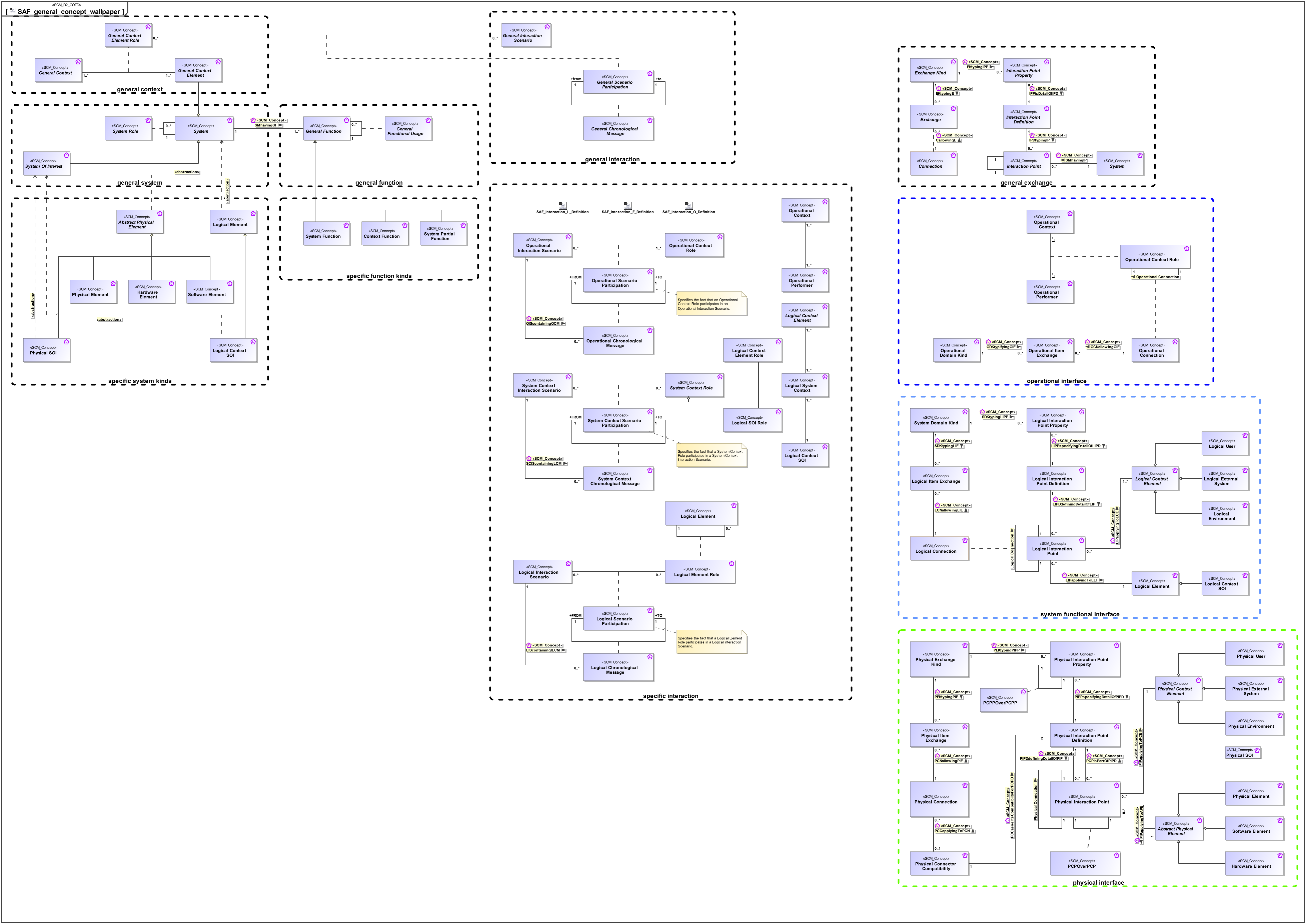
| Concept | Documentation |
|---|
| System Of Interest | An abstract element representing a SOI. Base class for specific kinds of SOIs. |
| Conceptual Context Element | Represents an abstract element in the given System Context on Conceptual Level, outside the SOI scope, interacting with the SOI. |
| Conceptual External System | A Conceptual External System in the Conceptual Domain, outside the SOI scope, interacting with the SOI. E.g., power grid, mobile network, fresh water system (in a house). |
| Conceptual System Context | Specifies the fact that a System Context for a System of Interest is defined on Conceptual Level. |
| Physical Environment | The Physical Environment in the Physical Domain, outside the SOI scope, interacting with the SOI. E.g. air, dirt, sun, road. |
| Logical Context SOI_ Deprecated | Represents the Logical SOI in the System Context on Logical Level. |
| Physical SOI | Represents the Physical SOI on Physical Level. |
| Physical Context Element | Abstract element of a System Context on Physical Level, outside the SOI scope, interacting with the SOI. |
| Physical External System | The Physical External System in the Physical Domain, outside the SOI scope, interacting with the SOI. E.g. power grid, mobile network, fresh water system (in a house). |
| Operational Interaction Scenario | Ordered sequence of exchanges of information, energy, or material between Operational Interaction Scenario Participants. |
| containing | Specifies the fact that an Operational Interaction Scenario contains one or more Operational Chronological Messages. |
| Conceptual Exchange Type | Specification for any type of conceptual item (energy, material, information, etc.) to be exchanged on Conceptual (Functional Architecture and Logical Architecture) Level. The Conceptual Exchange Type is agnostic to any realization on Physical Level. |
| Operational Chronological Message | Ordered sequential occurrence of exchanges between Operational Interaction Scenario Participants. |
| Operational Scenario Participation | Specifies the fact that an Operational Context Role participates in an Operational Interaction Scenario. |
| Operational Context | An Operational Context is representing a separate Usage Scenario with a specific configuration of Operational Performers, these are interacting in the Scenario exhibiting a specific identified Operational Capability. One or more Operational Contexts meaningful for the Operational Domain are to be identified. Aliases: UAF::HighLevelOperationalConcept |
| allowing | Specifies the fact that a Conceptual Item Exchange is allowed on the Conceptual Connection. |
| typing | Specifies the fact that a Conceptual Exchange Type defines the type of a Logical Item Exchange. |
| typing | Specifies the fact that a Conceptual Exchange Type defines the type of a Conceptual Interaction Point Property. |
| System Function | Specifies the fundamental action or task that have to take place in the System in accepting and processing the inputs and in processing and generating the outputs. A System Function * accepts input from the System boundary * exposes its output at the System boundary * changes the System's State * is dependent on System's State Note: A System Function does not need to expose observable output, when it changes the System's state in a way that is observable by other system functions. Furthermore, a System Function does not need to accept any input from the system boundary, when it is dependent on the System State, which in turn is changeable by other System Functions. |
| General Functional Usage | Specifies a General Usage of a General Function within one or more other General Functions. |
| Physical Interaction Point Property | Specifies a detail of an interaction point on Physical Level. |
| applyingTo | Specifies the fact that a Conceptual Interaction Point applies to a Conceptual System. |
| Software Element | Pure Software Elements. Similarity with the V-Model "software unit". |
| defining | Specifies the fact that a Conceptual Interaction Point Definition defines the exchange capabilities of a Conceptual Interaction Point. |
| specifying detail of | Specifies the fact that a Physical Interaction Point Property is a detail of a Physical Interaction Point Definition. |
| defining detail of | Specifies the fact that a Physical Interaction Point Definition defines the exchange capabilities of a Physical Interaction Point. |
| Physical Exchange Type | Specification for any kind of physical item (energy, material, information, etc.) to be exchanged on Physical Level. This is the realization of the specification made by System Domain Kinds. |
| typing | Specifies the fact that a Physical Exchange Kind defines the type of a Physical Item Exchange. |
| Conceptual Interaction Point | Specifies the existence of an interaction point on Conceptual Level. |
| typing | Specifies the fact that a Physical Exchange Kind defines the type of a Physical Interaction Point Property. |
| Physical Connection | Specifies the connection of two physical interaction points. Note: Connections between physical components indicate that item flows are passed from one output of a source component to one or more inputs of target components. |
| Conceptual Item Exchange | Specifies the exchange that is to take place on a connection of two interaction points on Conceptual Level. |
| applying to | Specifies the fact that a Physical Interaction Point applies to a Physical Context Element. |
| allowing | Specifies the fact that a Physical Item Exchange is allowed on the Physical Connection. |
| specifyingDetailOf | Specifies the fact that a Conceptual Interaction Point Property is a detail of a Conceptual Interaction Point Definition. |
| Physical Element | A composition of Hardware and Software Elements. Similarity with the V-Model segments and system. See [VXT]. |
| applying to | Specifies the fact that a Physical Interaction Point applies to an Abstract Physical Element. |
| Physical Interaction Point | Specifies the existence of an interaction point on Physical Level. |
| Hardware Element | Pure Hardware Elements. Similarity with the V-Model "hardware unit". |
| Conceptual System | Describes a conceptual system as specification for an implementation of a system. It is used in both functional and logical architectures on any hierarchy level. |
| applyingTo | Specifies the fact that a Conceptual Interaction Point applies to a Conceptual Context Element. |
| Conceptual Interaction Point Definition | Specifies the exchange capabilities of an interaction point on Conceptual Level. |
| Physical Item Exchange | Specifies the exchange that is to take place on a Physical Connection. |
| Abstract Physical Element | Abstract element representing physical structure items keeping properties and relations applicable to all physical items. |
| Physical Interaction Point Definition | Specifies the exchange capabilities of an interaction point on Physical Level. |
| Conceptual Interaction Point Property | Specifies a detail of an interaction point on Logical Level. |
| Conceptual Connection | Specifies the connection of two interaction points on Logical Level. Note: Connections between logical components indicate that item flows are passed from one output of a source component to one or more inputs of target components. |
| Conceptual Internal Role | Specifies the fact that a Conceptual System may consist of Conceptual Systems (a white box perspective on a conceptual system). |
| Conceptual Environment | A Conceptual Environment in the Conceptual Domain, outside the SOI scope, interacting with the SOI. E.g., air, dirt, sun, road. |
| Operational Performer | An Operational Performer is an element of the Operational Context that is capable to perform Operational Process Activities contributing to a specific identified Operational Capability. An Operational Performer may be any kind of organization, person, or even a system playing a role in one or more Operational Contexts. Aliases: UAF::OperationalPerformer |
| Operational Context Role | An Operational Context Role represents a participant in an Operational context. It is interacting with other roles of the given Operational Context. Specific characteristics and features or, in case of persons or organizational units, knowledge and skills are assigned to a role necessary for the execution of the performed Operational Processes. |
| General Context | Specifies a General Context. |
| General Context Element | Specifies a General Context Element. |
| General Context Element Role | Specifies the fact that a General Context Element exists in a given General Context. |
| Conceptual User | The Conceptual User is the representation for a human in the Conceptual Domain, outside the SOI scope, interacting with the SOI. |
| Conceptual Context Element Role | Specifies the fact that a Conceptual Context Element acts in a given Conceptual System Context. |
| Conceptual SOI Role | Specifies the fact that a Conceptual System acts as SOI exists in a given Conceptual System Context. |
| Physical User | The Physical User is the representation for a human in the physical domain, outside the SOI scope, interacting with the SOI. |
| Conceptual Interaction Scenario | Ordered sequence of exchanges of information, energy, or material between Conceptual Interaction Scenario Participants. |
| Conceptual Scenario Participation | Specifies the fact that a Conceptual Internal Role participates in a Conceptual Interaction Scenario. |
| Conceptual Chronological Message | Ordered sequential occurrence of exchanges between Conceptual Interaction Scenario Participants. |
| General Interaction Scenario | Ordered sequence of exchanges of information, energy, or material between General Interaction Scenario Participants. |
| General Scenario Participation | Specifies the fact that a System Role participates in a General Interaction Scenario. |
| General Chronological Message | Ordered sequential occurrence of exchanges between General Interaction Scenario Participants. |
| System Context Role | General role of a Logical System Context. |
| System Context Interaction Scenario | Ordered sequence of exchanges of information, energy, or material between System Context Interaction Scenario Participants. |
| System Context Scenario Participation | Specifies the fact that a System Context Role participates in a System Context Interaction Scenario. |
| System Context Chronological Message | Ordered sequential occurrence of exchanges between System Context Interaction Scenario Participants. |
| Operational Connection | Specifies the connection between Operational Context Roles in an Operational Context allowing Operational Item Exchange. Aliases: UAF::OperationalConnector |
| Operational Item Exchange | Specifies the Operational Item Exchange that is to take place on an Operational Connection. Aliases: UAF::OperationalExchange |
| allowing | Specifies the fact that an Operational Item Exchange is allowed on the Operational Connection. |
| Operational Exchange Type | Specifies the type of Operational Item Exchange between Operational Context Roles or Operational Processes. |
| characterising | Specifies the fact that an Operational Exchange Type characterises an Operational Item Exchange. |
| containing | Specifies the fact that a System Context Interaction Scenario contains one or more System Context Chronological Messages. |
| containing | Specifies the fact that an Conceptual Interaction Scenario contains one or more Conceptual Chronological Messages. |
| System Partial Function | Specifies the fact that a System Partial Function is a decomposed part of a System Function and defines details of the System Function it belongs to. |
| Context Function | Specifies the fact that a fundamental action or task is expected to be carried out by an External Entity. Note: The intention is to capture the expectations and to explicitly dissect the functionality. This must not be interpreted as an attempt for a behavior specification of an External Entity. Capturing this valuable information is the basis to reach agreement on the functionality at the System boundary by clarifying the expectations about what is performed by Context Elements. |
| General Function | Specifies a General Function. It is used as base Class for specific System or Context Functions, or Partial Functions. |
| Physical Connector Compatibility | Specifies the fact that two Physical Interaction Point Definitions are compatible and how the Physical Interaction Point Properties are mapped. |
| applying to | Specifies the fact that a Physical Connector Compatibility Assertion shall apply to a Physical Connection. |
| asserts compatibilty for | Specifies the Physical Interaction Point Definition the Physical Compatibility Assertion is valid for. |
| over | Specifies the fact that a physical interaction point communicates / transfers / flows / over an other physical interaction point. Used to define layered physical interfaces, and show layer relationships between interfaces. |
| over | Specifies the fact that a physical interaction point property communicates / transfers / flows / over an other physical interaction point property. Used to define layered physical interfaces, and show layer relationships between interface details. |
| is part of | specifies that a physical interaction point can be a part of a physical interaction point definition. This fosters reuse and allows structuring of definitions. |
| System | An abstract element representing a System. |
| System Role | Specifies, that a system is part of a system. |
| having | Specifies, that a system has general functions. |
| Interaction Point | Specifies the existence of an interaction point. |
| Interaction Point Definition | Specifies the exchange capabilities of an interaction point on Physical Level. |
| Exchange Kind | Specification for a general kind of item (energy, material, information, etc.) to be exchanged. |
| Interaction Point Property | Specifies a detail of an interaction point. |
| typing | Specifies the fact that an Interaction Point Definition defines the exchange capabilities of an Interaction Point. |
| is detail of | Specifies the fact that an Interaction Point Property is a detail of an Interaction Point Definition. |
| typing | Specifies the fact that a Exchange Kind defines the type of a Interaction Point Property. |
| Exchange | Specification for general item exchange (energy, material, information, etc.). |
| typing | Specifies the fact that a Exchange Kind defines the type of a Exchange. |
| Connection | Specifies the connection of two interaction points. |
| allowing | Specifies the fact that a connection allows Exchange to happen |
| having | Specifies the fact that a System has one or more Interaction Points. |