
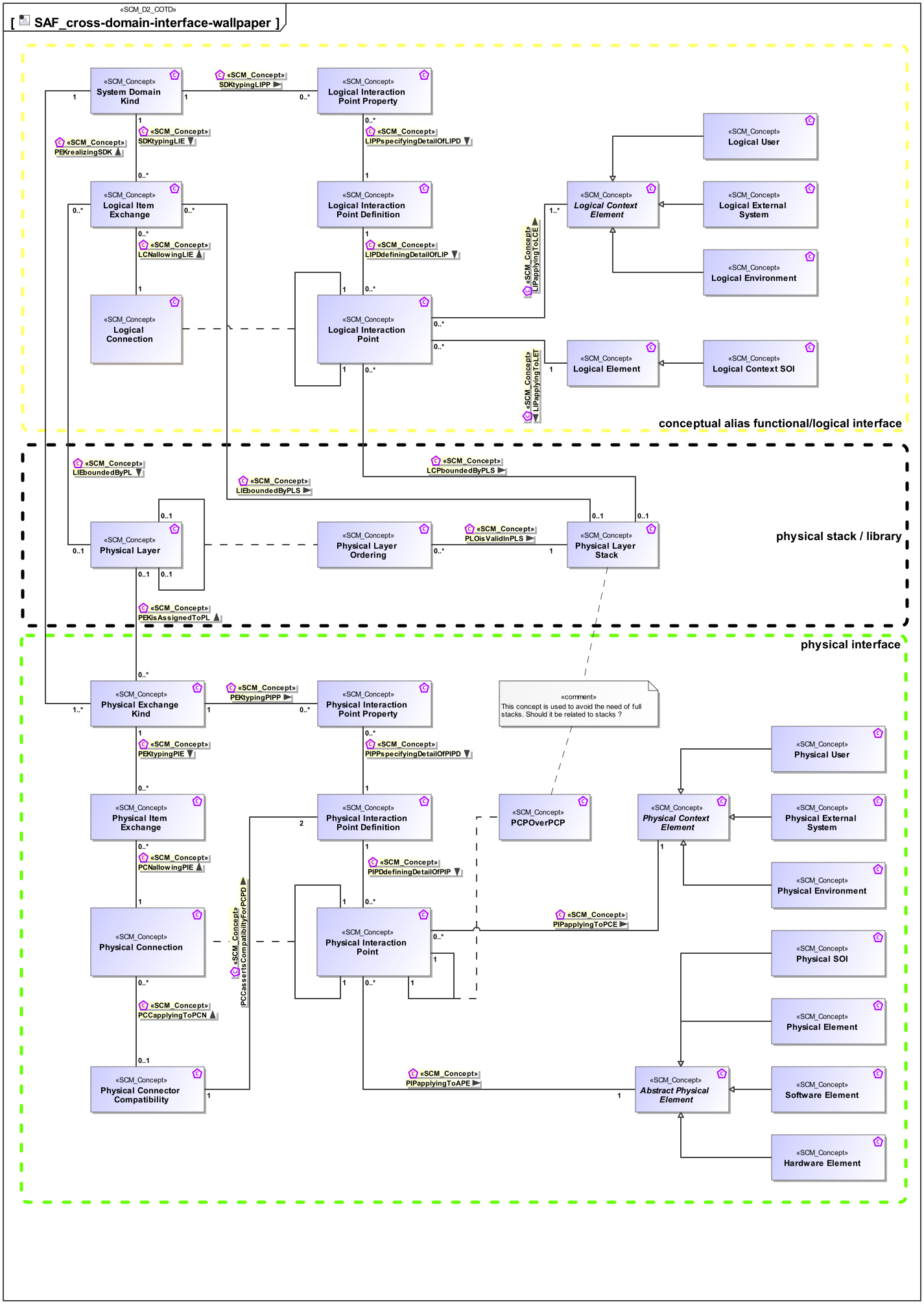
 Overview about the relationships between interface related concepts used in the SAF Functional/Logical Domain and the SAF Physical Domain
| Concept | Documentation |
|---|---|
| Conceptual Context Element | Represents an abstract element in the given System Context on Conceptual Level, outside the SOI scope, interacting with the SOI. |
| Conceptual External System | A Conceptual External System in the Conceptual Domain, outside the SOI scope, interacting with the SOI. E.g., power grid, mobile network, fresh water system (in a house). |
| Physical Environment | The Physical Environment in the Physical Domain, outside the SOI scope, interacting with the SOI. E.g. air, dirt, sun, road. |
| Logical Context SOI_ Deprecated | Represents the Logical SOI in the System Context on Logical Level. |
| Physical SOI | Represents the Physical SOI on Physical Level. |
| Physical Context Element | Abstract element of a System Context on Physical Level, outside the SOI scope, interacting with the SOI. |
| Physical External System | The Physical External System in the Physical Domain, outside the SOI scope, interacting with the SOI. E.g. power grid, mobile network, fresh water system (in a house). |
| Conceptual Exchange Type | Specification for any type of conceptual item (energy, material, information, etc.) to be exchanged on Conceptual (Functional Architecture and Logical Architecture) Level. The Conceptual Exchange Type is agnostic to any realization on Physical Level. |
| allowing | Specifies the fact that a Conceptual Item Exchange is allowed on the Conceptual Connection. |
| typing | Specifies the fact that a Conceptual Exchange Type defines the type of a Logical Item Exchange. |
| typing | Specifies the fact that a Conceptual Exchange Type defines the type of a Conceptual Interaction Point Property. |
| realizing | Specifies the fact that a Conceptual Exchange Type is realized by Physical Exchange Types. |
| Physical Interaction Point Property | Specifies a detail of an interaction point on Physical Level. |
| applyingTo | Specifies the fact that a Conceptual Interaction Point applies to a Conceptual System. |
| Software Element | Pure Software Elements. Similarity with the V-Model "software unit". |
| defining | Specifies the fact that a Conceptual Interaction Point Definition defines the exchange capabilities of a Conceptual Interaction Point. |
| specifying detail of | Specifies the fact that a Physical Interaction Point Property is a detail of a Physical Interaction Point Definition. |
| defining detail of | Specifies the fact that a Physical Interaction Point Definition defines the exchange capabilities of a Physical Interaction Point. |
| Physical Exchange Type | Specification for any kind of physical item (energy, material, information, etc.) to be exchanged on Physical Level. This is the realization of the specification made by System Domain Kinds. |
| typing | Specifies the fact that a Physical Exchange Kind defines the type of a Physical Item Exchange. |
| Conceptual Interaction Point | Specifies the existence of an interaction point on Conceptual Level. |
| typing | Specifies the fact that a Physical Exchange Kind defines the type of a Physical Interaction Point Property. |
| Physical Connection | Specifies the connection of two physical interaction points. Note: Connections between physical components indicate that item flows are passed from one output of a source component to one or more inputs of target components. |
| Conceptual Item Exchange | Specifies the exchange that is to take place on a connection of two interaction points on Conceptual Level. |
| applying to | Specifies the fact that a Physical Interaction Point applies to a Physical Context Element. |
| allowing | Specifies the fact that a Physical Item Exchange is allowed on the Physical Connection. |
| specifyingDetailOf | Specifies the fact that a Conceptual Interaction Point Property is a detail of a Conceptual Interaction Point Definition. |
| Physical Element | A composition of Hardware and Software Elements. Similarity with the V-Model segments and system. See [VXT]. |
| applying to | Specifies the fact that a Physical Interaction Point applies to an Abstract Physical Element. |
| Physical Interaction Point | Specifies the existence of an interaction point on Physical Level. |
| Hardware Element | Pure Hardware Elements. Similarity with the V-Model "hardware unit". |
| Conceptual System | Describes a conceptual system as specification for an implementation of a system. It is used in both functional and logical architectures on any hierarchy level. |
| applyingTo | Specifies the fact that a Conceptual Interaction Point applies to a Conceptual Context Element. |
| Conceptual Interaction Point Definition | Specifies the exchange capabilities of an interaction point on Conceptual Level. |
| Physical Item Exchange | Specifies the exchange that is to take place on a Physical Connection. |
| Abstract Physical Element | Abstract element representing physical structure items keeping properties and relations applicable to all physical items. |
| Physical Interaction Point Definition | Specifies the exchange capabilities of an interaction point on Physical Level. |
| Conceptual Interaction Point Property | Specifies a detail of an interaction point on Logical Level. |
| Conceptual Connection | Specifies the connection of two interaction points on Logical Level. Note: Connections between logical components indicate that item flows are passed from one output of a source component to one or more inputs of target components. |
| Conceptual Environment | A Conceptual Environment in the Conceptual Domain, outside the SOI scope, interacting with the SOI. E.g., air, dirt, sun, road. |
| Conceptual User | The Conceptual User is the representation for a human in the Conceptual Domain, outside the SOI scope, interacting with the SOI. |
| Physical User | The Physical User is the representation for a human in the physical domain, outside the SOI scope, interacting with the SOI. |
| Physical Connector Compatibility | Specifies the fact that two Physical Interaction Point Definitions are compatible and how the Physical Interaction Point Properties are mapped. |
| applying to | Specifies the fact that a Physical Connector Compatibility Assertion shall apply to a Physical Connection. |
| asserts compatibilty for | Specifies the Physical Interaction Point Definition the Physical Compatibility Assertion is valid for. |
| Physical Layer | Specifies a Physical Layer, usually used for communication. |
| Physical Layer Stack | Specifies a detail of an interaction point on Physical Level. |
| Physical Layer Ordering | Specifies an order among two physical layers. This order is valid within a Physical Layer Stack |
| is valid in | Specifies the fact that a Physical Layer Ordering is valid within a particular Physical Layer Stack. |
| is assigned to | Specifies the fact that a Physical Exchange Kind is assigned to a particular Physical Layer. |
| bounded by | Specifies the fact that a Logical Item Exchange is constrained to be implemented on a particular Physical Layer. |
| bounded by | Specifies the fact that a Logical Item Exchange is constrained to be implemented on a particular Physical Layer Stack. |
| bounded by | Specifies the fact that a Logical Interaction Point is constrained to be implemented on a particular Physical Layer Stack. |
| over | Specifies the fact that a physical interaction point communicates / transfers / flows / over an other physical interaction point. Used to define layered physical interfaces, and show layer relationships between interfaces. |